Ad recommendations that name their source
Valkiria reads the synced metrics of your campaigns over the last 30 days and turns them into a list of things worth fixing — each with a priority, a difficulty estimate and a link to the number it grew from. No recommendation is ever applied to the account by itself.
01What hurts
Why good advice never reaches the account
Plenty of data, no priority
Reports show dozens of sagging metrics at once. Which to fix first — the worst CPA or the campaign burning the most money — ends up being decided by feel.
Advice without a source is ignored
“Raise the bids” with no number attached reads as an opinion. The team quite reasonably asks for evidence, and the recommendation stalls indefinitely.
The task list dissolves into chat
Recommendations scatter across threads and calls, and a week later nobody remembers what was done, what was rejected, and for what reason.
Scroll to see it work
Recommendations in four moves
- 01Scattered
Without Recommendations, this work is spread across spreadsheets and tabs.
- 02Connected
Recommendations reads the accounts and data you have already connected.
- 03Found
It highlights what matters now, with the evidence behind it.
- 04Approved
You decide what happens next: what applies on its own and what waits for approval.
02How it works
How a recommendation travels from metric to task
- 01
Collect the account metrics
Campaign performance for the last 30 days is pulled from your connected platforms: CTR, CPC, CPA, ROAS, spend, conversions and revenue per campaign.
- 02
Build the prioritised list
The model analyses only those numbers and returns tasks with impact, difficulty, confidence and a reference to the source behind each finding.
- 03
You decide on each one
Mark a recommendation done or dismiss it, both behind a confirmation. Neither action writes anything into the advertising account.
03What you get
What the recommendation list gives you
Every finding names its source
A recommendation carries the platform, the campaign and the 30-day window it was derived from, so the reasoning can be checked in a minute.
01The forecast is labelled an estimate
Expected impact is signed as an estimate rather than a measured result: the fact is the metric the recommendation grew out of.
02Priority by impact and difficulty
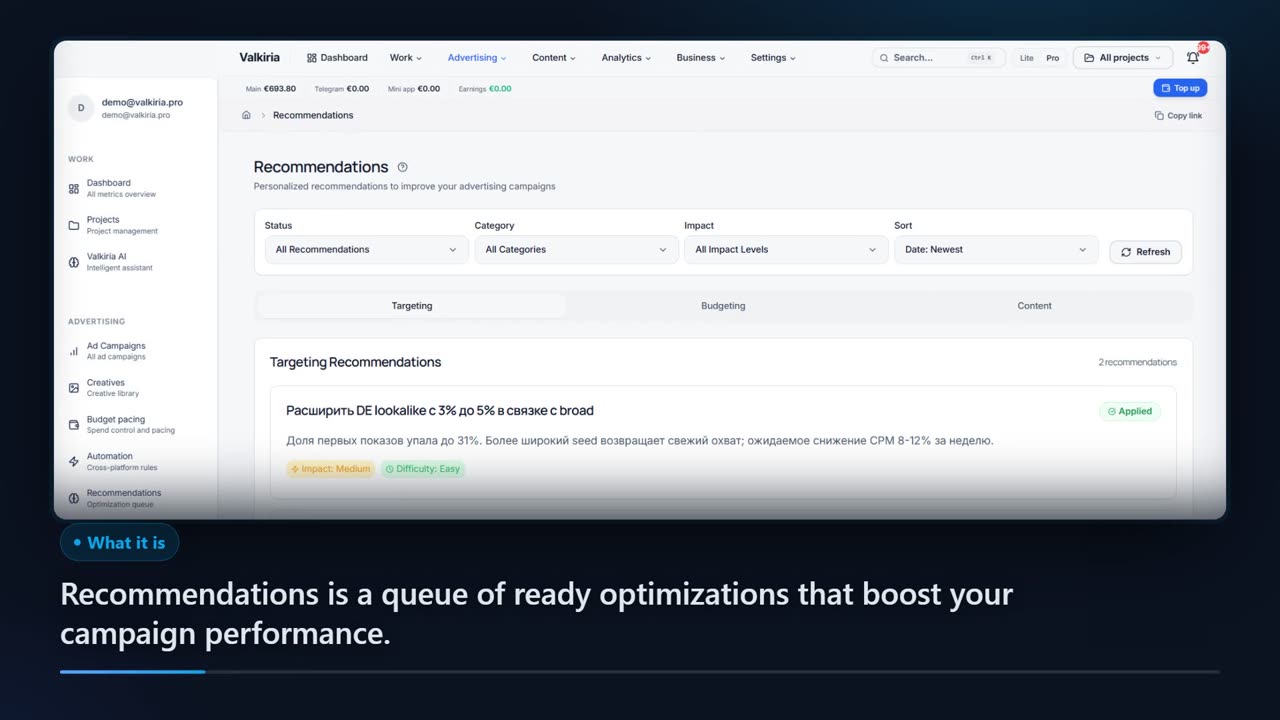
High, medium and low impact plus difficulty and confidence, so the work queue lines up without an argument about taste.
03Three tracks in one list
Targeting, budget and creative sit in separate tabs, so each task reaches the person who actually owns that part of the account.
04Filters and sorting
Filter by status, category and impact, sort by date or impact: the ten lines you care about are two clicks away.
05Export and notification
The whole list exports to PDF for a client report, and a new batch of recommendations arrives as an in-app notification.
0604In numbers
- 30
- days of account metrics behind each recommendation
- 3
- tracks: targeting, budget and creative
- OFF
- live edits until you switch them on for an account
Who gets what
What each type of client takes away
What you connect
- Ad accounts
- Analytics
- Website
- Bank & invoices
What Valkiria does
- 01Collect spend and results
- 02Find leaks and gaps
- 03Propose next steps
What you get
- Action plan
- Owner report
- Spend control
See every ad budget and what it returns, without opening five dashboards
Google, Meta, TikTok and the rest in one view, in your currency, with results next to costs.
Findings turn into a prioritised list of next steps with the evidence behind each one.
New campaigns are created paused. Edits to live campaigns stay off until you switch them on for an account; deletions and new spend always wait for approval.
Modules that do the work
05FAQ
Questions about recommendations
06See also
All modulesStart now
Start with ten tasks, not a hundred charts
Connect your accounts and get a list of what is worth fixing, with a source under every line. Your campaigns stay untouched while you read it.