ASO starts with a store link, not with access
Paste an App Store or Google Play link — the platform is detected from the URL and the audit reads keywords, competitors, reviews, visuals and metadata. Every score opens up to its inputs, its weights and the source the data came from.
01What hurts
Why the store never surfaces your app
Metadata was written once, at launch
Title, subtitle and description were set on release day and never revisited: store limits, keywords and the What's New field have sat untouched ever since.
Keywords live in someone's spreadsheet
Rankings get checked by hand and irregularly, so a drop is noticed through the install count rather than through the store results.
Reviews are read at random
The rating slides and the reason stays a guess: nobody counts which topics repeat across a thousand reviews, or in what mood.
Scroll to see it work
ASO Toolkit in four moves
- 01Scattered
Without ASO Toolkit, this work is spread across spreadsheets and tabs.
- 02Connected
ASO Toolkit reads the accounts and data you have already connected.
- 03Found
It highlights what matters now, with the evidence behind it.
- 04Approved
You decide what happens next: what applies on its own and what waits for approval.
02How it works
Three steps from a link to a fix list
- 01
Paste the store link
App Store or Google Play — the platform is detected from the URL. Several links can go in at once and queue up for analysis together.
- 02
Run the audit
The pass reads metadata, keywords, competitors, reviews and visuals, and returns scores for visibility, conversion, keywords, visuals and reviews.
- 03
Fix in priority order
Issues are sorted by severity with recommendations beside them, and the result exports to JSON, so the next audit shows the difference.
03What you get
What the ASO module covers
Both stores, several apps
App Store and Google Play in one interface; the iOS and Android builds of the same product are analysed in parallel with shared progress.
01Keywords with honest metrics
AI keyword discovery, search popularity, difficulty, chance of ranking and the current position with its change since the previous pull.
02Competitors from the store itself
Direct and indirect competitors found in the store, with their category, rating and average score sitting right next to yours.
03An audit that ranks the problems
Scores for visibility, conversion, keywords, visuals and reviews, an issue list ordered by severity, recommendations and a JSON export.
04Visuals and metadata against store limits
Icon, screenshots, preview video and field completeness: title, subtitle or short description, description and What's New, each against the store's character limit.
05Reviews as a source of reasons
Rating distribution, the sentiment split and the topics that keep recurring — instead of scrolling the review feed at random.
0604In numbers
- 2
- stores in one module: App Store and Google Play
- 6
- audit scores: overall, visibility, conversion, keywords, visuals, reviews
- 0
- App Store Connect or Play Console credentials needed — a public link is enough
Who gets what
What each type of client takes away
What you connect
- Ad accounts
- Analytics
- Website
- Bank & invoices
What Valkiria does
- 01Collect spend and results
- 02Find leaks and gaps
- 03Propose next steps
What you get
- Action plan
- Owner report
- Spend control
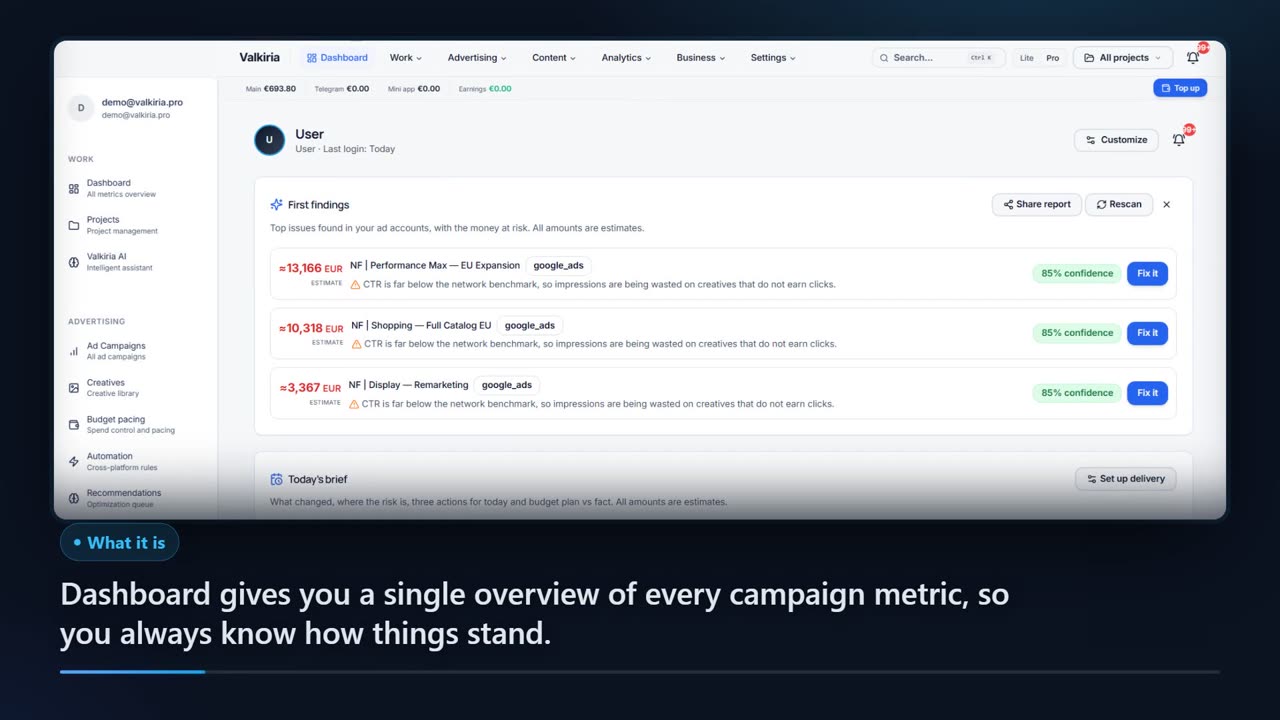
See every ad budget and what it returns, without opening five dashboards
Google, Meta, TikTok and the rest in one view, in your currency, with results next to costs.
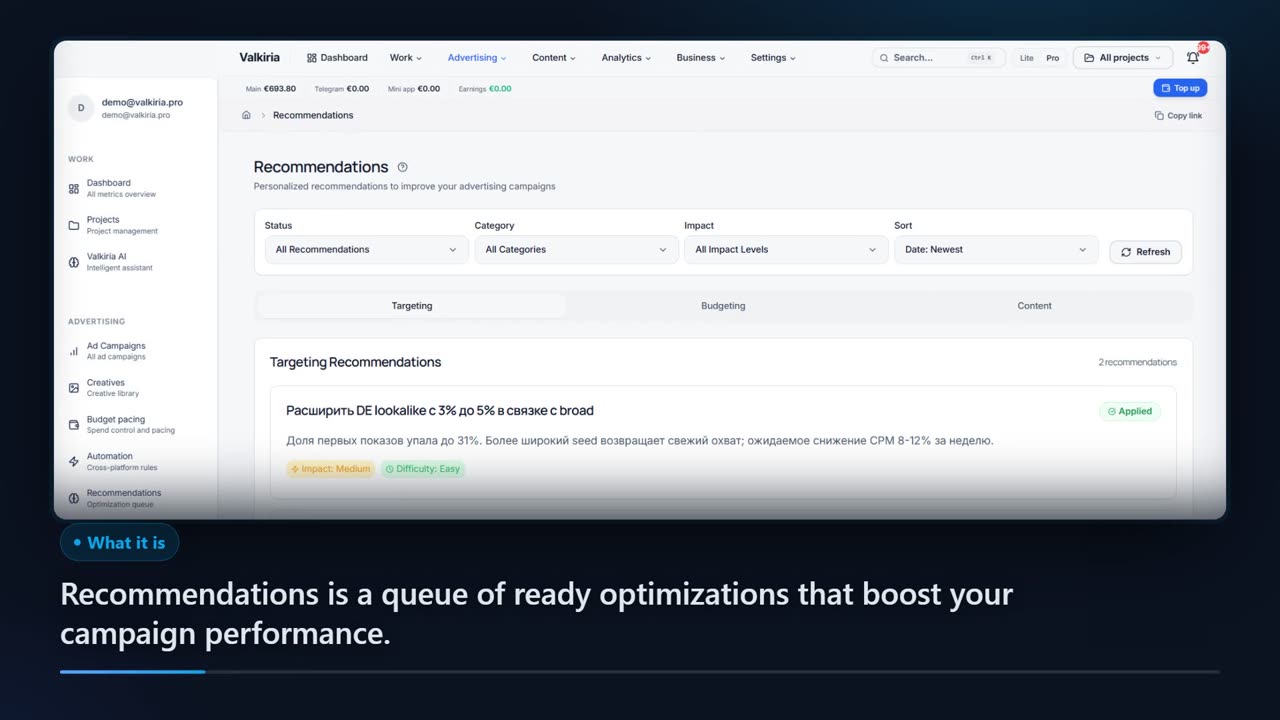
Findings turn into a prioritised list of next steps with the evidence behind each one.
New campaigns are created paused. Edits to live campaigns stay off until you switch them on for an account; deletions and new spend always wait for approval.
Modules that do the work
05FAQ
Questions about the ASO module
06See also
All modulesStart now
Start with one link to your app
No credentials and no console exports: the audit starts on the public store page and ends with a list of fixes.